
Workshop at CHI2026 Barcelona, 15 April, 2026 – 14.15-18.00
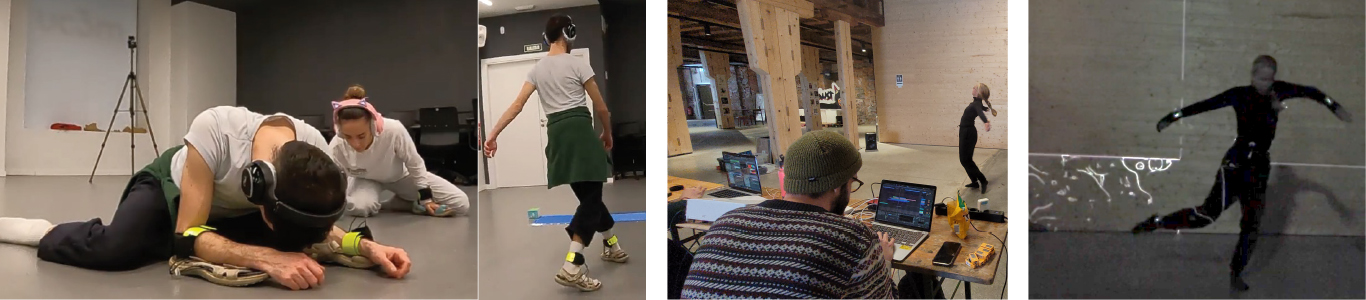
From Movement to Sound and Back: movement sonification in artistic expression during workshop (left) and performance (right) Middle: using the Movement-Sonification toolkit as basis for the performance.
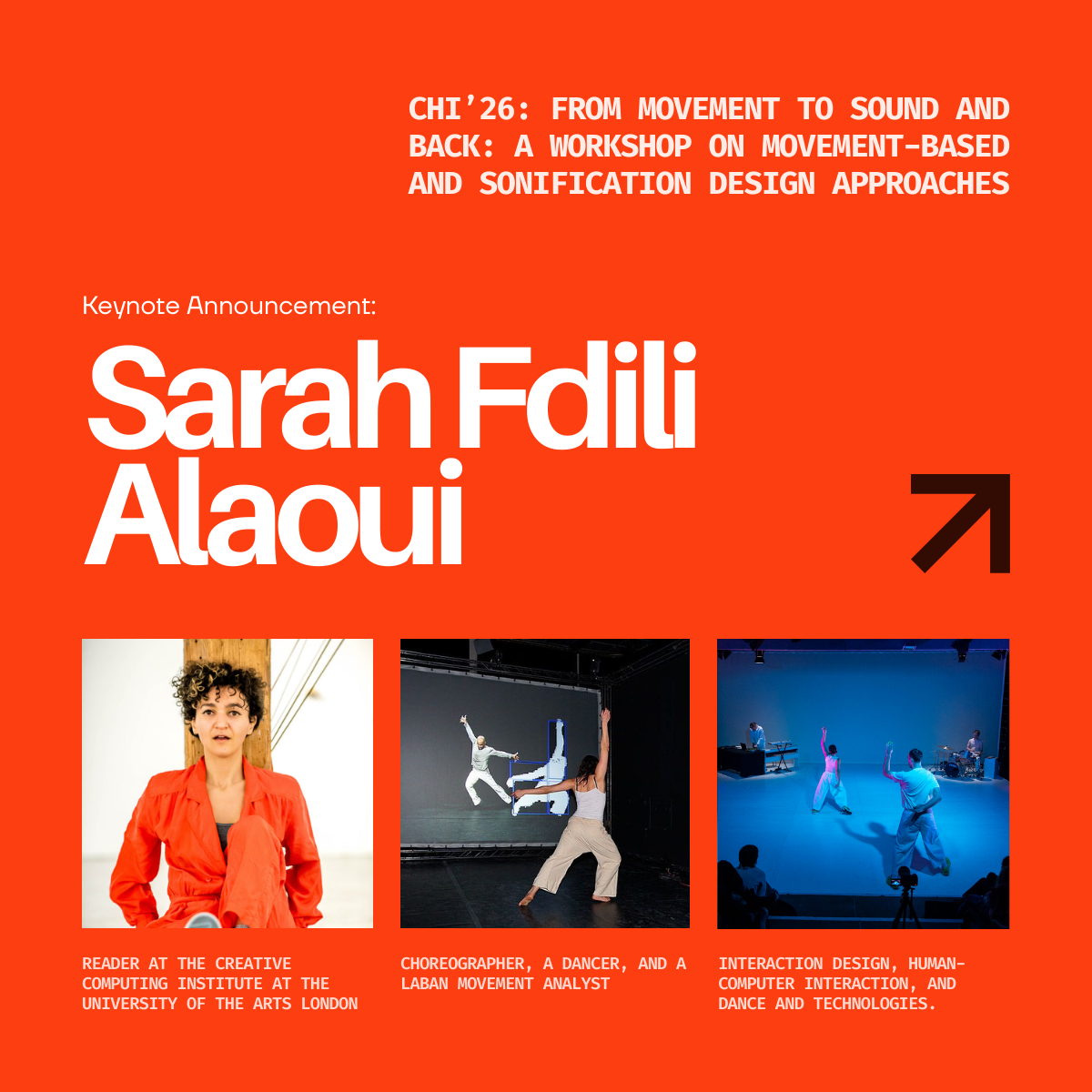
Keynote by Sarah Fdili Alaoui
Overview
Movement and sound are intrinsically connected; movement makes sound and sound makes movement. In this playful workshop we aim to unite sonification researchers, music enthusiasts, sound engineers, with movement experts such as SportsHCI researchers, and beyond to engage in a hands-on exchange.
The aim of the workshop is to understand how sound can guide movement, and how movement in turn can guide sound design. We will use movement-based design approaches to reflect on the sound design, and use sonification approaches to further understand movement.
We will use a novel movement sonification tool aiding non-sound experts to easily generate and explore movement sonifications.
Link to pre-print paper
Intended Audience
We welcome HCI researchers with a background in movement-based design, sonification and audio design, SportsHCI, and beyond, to join the workshop. We also welcome attendees with expertise in soma design and performance arts. In general participants from all stages in the academic career are welcome.
Long (2x 90 min) Workshop – 15 April, 2026 – 14.15-18.00
This half-day workshop features two interactive 90-minute sessions designed to spark exploration and collaboration. The program will include a keynote presentation, along with short demos or video showcases from participants. Following the presentations, we’ll introduce the sonification toolkit and break into small groups to experiment with movement and sonification strategies—each with a specific focus on either movement design or sonification design. The workshop will conclude with group discussions to reflect on the creative process, share insights, and examine the challenges encountered along the way.
Preliminary workshop plan:
The activities will be organized according to the following timeline:
• 25 mins: Workshop introduction and keynote
• 30 mins: Activity 1: Participant introductions will showcase their movement/sonification examples and discuss challenges and key insights related to movement sonification design. These contributions will be organized collectively on a shared post-it wall.
• 5 mins: Break
• 30 mins: Activity 2: Movement Sonification toolkit introduction in which participants will try out the toolkit and explore its possibilities. Participants will connect sample movement data to sound parameters and experiment with simple mappings to understand the toolkit’s interaction logic.
• Main Break
• 45 mins: Activity 3: Hands-on Exploring of Movement and Sonification in which participants will go through a design iteration of a movement or sonification design — using either movement as input for sonification or vice versa. Each group will select a movement scenario, choose relevant data streams and create a mapping using the toolkit. They will produce a simple sonification sketch or movement concept that can be shown and discussed in Activity 4.
• 5 mins: Break
• 25 mins: Activity 4: Participant Presentations and Reflections in which participants will share the outcomes of activity 3 and reflect on the methodology used. The outcomes will be collected to identify common strategies and challenges across groups.
• 15 mins: Closing: Next steps and future collaboration.
Call for Participation
Movement and sound are inherently interwoven: movement generates sound, sound motivates movement. This workshop explores how sonification design approaches and movement-based design approaches can enhance, accelerate, and amplify each other. How can movement inform sonification design? And how can sonifications help movement-based design approaches?
In this hands-on workshop participants will be introduced to a movement-sonification toolkit and explore designing for sound through movement and designing for movement through sound.
We invite HCI researchers that work within the scope of designing interactive systems with emphasis on sound and or movement.
Prospective participants are be invited to submit a 2-4 position paper (acm two-column format) including the following information:
• Background: Describing the participant’s experience with movement/sonification projects.
• Describe a sonification system that they developed, participated, or experienced.
• Write a reflection including 3 key challenges and 3 key insights when designing movement/sonification systems.
To apply please fill out the following google form.
We will accept applicants on “tumbling” basis (for a lack of better wording that I can find at this hour), meaning we will have 3 moments of acceptance:
_End of FEB for those needing to have an answer before the early bird registration deadline (if you need earlier feedback please contact vvr)
_12 March AOE (in order to give us a feeling how much participants we have at that moment – potentially needing to limit the amount of participants we can accept for the last round, if any)
_26 March AOE (for last participants entering – again, we might need to limit the participants at this point)
We will provide feedback at each of those time points – feel free to enter at any of them, take in mind that we limit the number of participants to 30. Also feel free to already put a draft version so we start having an idea how many participants still to expect to apply (put “draft” somewhere so we know that we’re not already providing you feedback for that round).
Based on your inputs we aim to create an inspiring and plural group – wohoo! (that’s sonification for ya)
Organizers
Michael Reichmann – University of Salzburg, Austria
Vincent van Rheden– University of Salzburg, Austria
Hakan Yılmazer – Koç University, Turkey
Daniel Hug – Zurich University of the Arts, Switzerland
Hongyue Wang – Exertion Games Lab, Monash University, Australia
Nina Schaffert – University of Hamburg / BeSB GmbH, Germany
Maria F. Montoya – Exertion Games Lab, Monash University, Australia
Laia Turmo Vidal – KTH Royal Institute of Technology, Sweden
Alexander Meschtscherjakov – University of Salzburg, Austria
Florian “Floyd” Mueller – Exertion Games Lab, Monash University, Australia